|
What's the Procedure for Having a Tooth Bonded?
Preparation
Little advance
preparation is needed for dental bonding. Anesthesia is often not
necessary unless the bonding is being used to fill a decayed tooth.
Our doctor will use a shade guide to select a composite resin color
that will closely match the color of your tooth.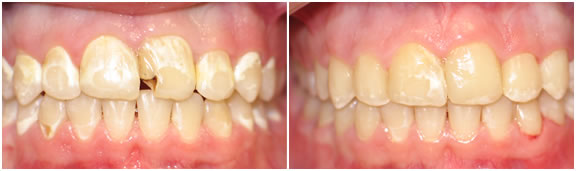
The bonding process
Next, the
surface of the tooth will be roughened and a conditioning liquid
applied. These procedures help the bonding material adhere to the
tooth. The tooth-colored, putty-like resin is then applied, molded,
and smoothed to the desired shape. An ultraviolet light or laser is
then used to harden the material. After the material is hardened,
our doctor will further trim and shape it, and polish it to match
the sheen of the rest of the tooth surface.
Time-to-completion
Dental
bonding takes about 30 to 60 minutes per tooth to complete.
What Are the Advantages and Disadvantages of Dental Bonding?
Advantages: Dental bonding is
among the easiest and least expensive of cosmetic dental procedures.
Unlike veneers and crowns, which are customized tooth coverings that
must be manufactured in a lab, bonding usually can be done in one
office visit unless several teeth are involved. Another advantage,
compared with veneers and crowns, is that the least amount of tooth
enamel is removed. Also, unless dental bonding is being performed to
fill a cavity, anesthesia is usually not required.
Disadvantages: Although the
material used in dental bonding is somewhat stain resistant, it does
not resist stains as well as crowns. Another disadvantage is that
the bonding materials do not last as long nor are as strong as other
restorative procedures, such as
crowns,
veneers, or
fillings.
Additionally, bonding materials can chip and break off the tooth.
Because of some of the limitations of dental bonding, some dentists
view it as best suited for small cosmetic changes, for temporary
correction of cosmetic defects, and for correction of teeth in areas
of very low bite pressure (for example, front teeth). Consult
Dr. Eva Goriee
about the best cosmetic approach for your particular problem.
How Long Does Bonding Material Last?
The lifespan of bonding materials for the teeth depends on how much
bonding was done and your oral habits. Typically, however, bonding
material lasts from three years up to about 10 years before needing
to be touched up or replaced.
Smile Shapers Dentist Office for
Family Dentistry and Cosmetic Dental Services is located at the
Forum at Gateways Center, on the Southwest Corner of Mound Road and
Hall Road (M-59) in Sterling Hts., Michigan. Serving Rochester and
Rochester Hills, Troy, Utica, Shelby Twp., Sterling Heights MI., and
all other surrounding Oakland & Macomb County communities in
Metropolitan Detroit's northern suburbs. |







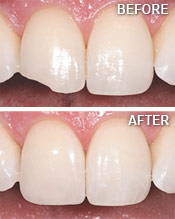 Dental
bonding is an option that can be considered:
Dental
bonding is an option that can be considered: To repair decayed teeth (composite resins for
cavities)
To repair decayed teeth (composite resins for
cavities)